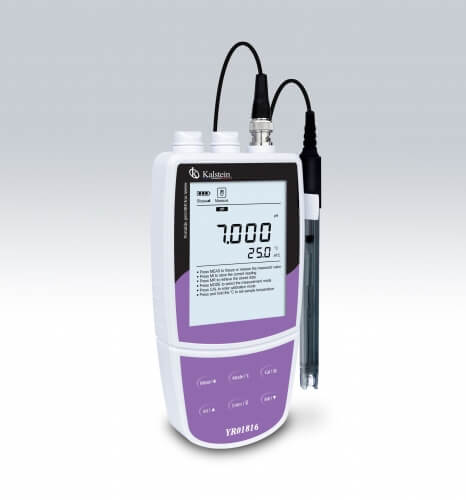
Understanding the Scientific Principles Behind the YR01817-13 Portable Ammonium Ion Meter
The YR01817-13 Portable Ammonium Ion Meter is a sophisticated instrument designed for measuring ammonium ion concentrations with high accuracy. This article delves into the scientific principles that underpin its operation, shedding light on the physical and chemical mechanisms that enable precise measurements.
Principle of Operation
The YR01817-13 operates based on the principle of ion-selective electrodes (ISEs). These electrodes selectively respond to specific ions in a solution, allowing for the determination of ion concentration. When a sample containing ammonium ions is placed in contact with the ISE, a potential difference is generated between the electrode and the reference electrode, which is proportional to the logarithm of the ammonium ion activity. The underlying equation governing this relationship is the Nernst equation, which states:
E = E0 + (RT/nF) * ln([An])
In this equation, E is the measured potential, E0 is the standard electrode potential, R is the universal gas constant, T is the temperature in Kelvin, n is the charge number of the ion, F is Faraday's constant, and [A] is the ion concentration. The instrument’s ability to provide accurate readings hinges on careful calibration, typically involving 2 to 5 points across low to high concentrations.
Key Design Choices and Features
The YR01817-13 is designed to be user-friendly and versatile, making it suitable for various applications. One notable feature is its backlit LCD screen, which enhances visibility under different lighting conditions. The automatic temperature compensation mechanism ensures that readings remain accurate across a range of temperatures, as ammonium ion activity can fluctuate with temperature changes.
Additionally, the device supports selectable concentration units (PPM, mg/L, and mol/L), catering to different user needs. The expanded memory can store up to 500 data sets, allowing for efficient data management in field applications. These design choices reflect a focus on practical user dynamics, ensuring that the YR01817-13 meets the demands of both laboratory and outdoor environments.
Specifications of the YR01817-13
| Model | YR01817-13 |
|---|---|
| Measurement Range | 5 × 10⁻⁶ to 1 M, 0.1 to 18000 ppm |
| Resolution | 0.001, 0.01, 0.1, 1 |
| Accuracy | ± 0.5% FS |
| Calibration Points | 2 to 5 points |
| Available Units | ppm, mg/L, mol/L, mmol/L |
| Data Storage Capacity | Up to 500 data sets |
| Power Supply | 3 AA batteries or DC5V adapter |
| Dimensions | 170 × 85 × 30 mm |
| Weight | 300 g |
Calibration Process
To ensure the accuracy of the YR01817-13, calibration is critical. Users can calibrate the device using standard solutions that span the expected concentration range of ammonium ions. This process typically involves the following steps:
- Prepare calibration solutions at known concentrations.
- Connect the device to a power source and turn it on.
- Select the calibration mode on the device.
- Immerse the electrode in the first calibration solution and wait for a stable reading before saving the value.
- Repeat the process for each calibration point.
The YR01817-13 can accommodate up to 5 calibration points, which enhances its accuracy across varying concentrations.
Common Operational Challenges
While the YR01817-13 is designed for reliability, users may encounter challenges that impact performance. Here are some common issues along with potential solutions:
| Symptom | Possible Causes | Solutions |
|---|---|---|
| Device does not power on | Dead batteries, faulty connections | Check battery connections; replace batteries |
| Error code E-03 | Calibration failure, electrode issues | Recalibrate; inspect the electrode for damage |
| Inconsistent readings | Contaminated samples, poor electrode condition | Clean the electrode; check sample purity |
Frequently Asked Questions
What is the significance of using a Portable Ammonium Ion Meter like the YR01817-13?
The YR01817-13 allows for accurate and convenient measurement of ammonium ion concentrations in various environments, making it essential for applications in agriculture, environmental monitoring, and laboratory analysis.
How does temperature affect the readings of the YR01817-13?
Temperature fluctuations can impact ion activity, thus altering measurements. The YR01817-13 includes automatic temperature compensation to mitigate these effects and ensure accuracy across a wide temperature range.
What are the calibration solutions required for the YR01817-13?
Calibration solutions for the YR01817-13 typically include standard ammonium chloride solutions that cover the expected concentration range of your measurements. These should be prepared accurately to achieve reliable calibration.
Can the YR01817-13 be used in the field?
Yes, the YR01817-13 is designed for both laboratory and field use, featuring a durable construction and portable design that allows for measurements in various outdoor conditions.
What maintenance is required for the YR01817-13?
Regular maintenance includes cleaning the electrode, performing routine calibrations, and checking for software updates if applicable. It ensures longevity and consistent performance in measurements.
How can I ensure accurate measurements with the YR01817-13?
To ensure accuracy, always calibrate the device according to the manufacturer’s guidelines, use clean samples, and maintain the electrode in good condition. Regular checks and maintenance are crucial.
Where can I request a quote for the YR01817-13?
You can request a quote on Kalstein Plus to obtain the YR01817-13 Portable Ammonium Ion Meter at competitive pricing.
If you are looking for a fusion of innovation and quality, you have come to the right place. At Kalstein, we offer you the luxury of exploring our exclusive catalog of laboratory equipment. We manufacture every device to the highest standards of excellence. Our intuitive and seamless online purchasing channels are designed for your convenience, securing the most competitive prices. Hesitate no longer — we bring science to life, it is time to become part of our community.